

Despite being nearly 20 years old at this point, Vocaloid remains one of the most misunderstood musical developments of the 21st century outside of Japan. Both in publicly viewable articles and in no shortage of private communications I’ve been wrapped up in the past year, the concept around what amounts to software that generates a voice continues to baffle people. Is it a robot? Is it AI? Is it anime? Can I marry Hatsune Miku? (No).
What surprises me the most in 2026, however, is how Vocaloid still often gets painted as “weird.” If the actual music coming out of the community got slapped with that one I’d get it — something like this is genuinely brain scrambling — but it’s the continued “uhhhhh the cartoon girl is singing, WTF?”
Maybe part of my confusion on this is how much Vocaloid culture has become ingrained in global online youth culture in recent years. You’d think after hyperpop and viral hits and how much time music writers spend on Twitter this would come across1, but I think it’s a gap in understanding how this instrument and the culture around it has been embraced by younger people that leads to a lot of confusion in 2026.
Perhaps they should consider listening to an EP made by a literal child offering arguably the most mainstream example of this development in the West to date.
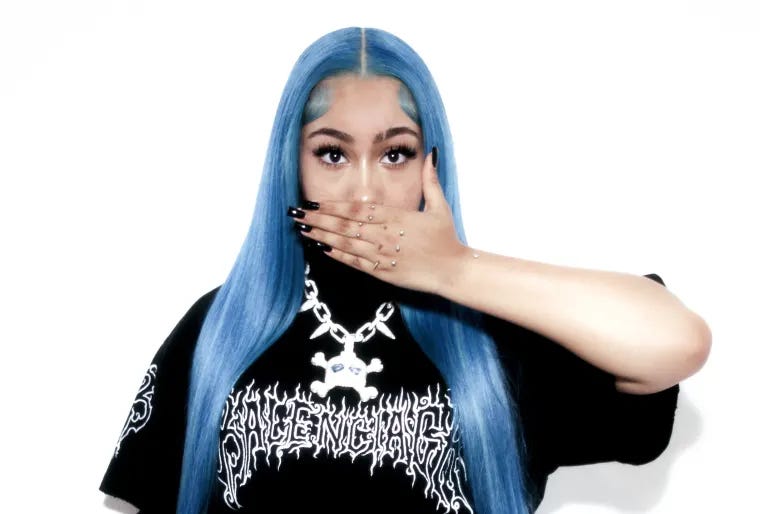
The most dizzying aspect of North West’s debut EP N0rth4evr is how it synthesizes what a Hot Topic would sound like in 2026. I always end up inside the one located in the biggie-sized mall near my parent’s house when I visit annually. While I never buy anything from the joint, I do leave with the knowledge of what American teens have at least some passing interest in.
In the 2020s that appears to be well-worn emo, rap, shiny things, anime and Hatsune Miku.
Twelve-year-old North West is mostly a perfect representative for this demographic and its interests, though her being the daughter of Ye (formerly Kanye West) and Kim Kardashian does muck matters up and makes N0rth4evr a trickier release to really analyze. That’s because coming from a billionaire family means your Vocaloid-featuring music is going to get attention that, say, a junior high schooler in the suburbs of Chicago will never approach (let alone filled with boasts about their closet space).
Still, move past nepo origins and the sins of her father if you can, and you get an EP that is…fine, sometimes pretty good. It’s just hyperpop / digicore / whatever-you-want-to-call-internet-fried-dance-pop wave, one constructed out of Aughts-era nostalgia only a moody kid of today could think is worth returning to (most prominently being the sample of Meg & Dia’s MySpace-era angst trudge “Monster” on the opening song) and guitar samples galore. It can be a little one note in how much it submerges itself in woe-is-me rock, but West offers details that help to at least temporarily brush some brighter colors onto these tracks (a “Caramelldansen” sample????).
I think those moments plus the real reason I’m interested in this one have made N0rth4evr more interesting than anything released by Frost Children or 2holis to name two critically hailed-ish names in this space.
Yet where I’m fascinated by this EP is in how prominent Vocaloid is in the world of North West. It’s literally on every song here via the chirpy Miku-delivered “Nosu-chan!” tag popping up at a rate that borders on Nyan-Cat-annoying. She herself presents it as something worth flexing, especially via the line “Miku hair / you can call me a Vocaloid,” a moment that had me acting like Funkmaster Flex in how I was rewinding.
It’s perhaps a slight leap in faith to prescribe this to the whims of a single child set for the good life forever…but I see N0rth4evr as an example of how ubiquitous Hatsune Miku has become. Again, I return to the malls of America in my head to peak into the Hot Topic of recent memory to gaze upon black t-shirts featuring and figurines of the aqua-haired avatar for Vocaloid. How did North West encounter Miku? Who knows, but it isn’t farfetched that she would. Miku is everywhere on the internet2 to the point of spilling into North American retail spaces, and plenty of younger folks would be aware of her even if they never opened up a DAW in their life.
A very surface-level reading of N0rth4evr is as representative of youth trends — the kids love Miku and MySpace and Europop and feeling miserable. But North West drills into why modern Vocaloid connects with so many listeners, in a way few Western artists have ever approached.
As Hatsune Miku’s profile rose in the 2010s, a handful of Western artists were drawn to her spectacle. Lady Gaga had her open for part of her The ARTPOP Ball in 2014, while Big Boi sampled her digi warble for 2017’s “Kill Jill.” I don’t have anything against either of these moves, but both have always struck me as leaning into the absurdity of Miku rather than trying to drill into the emotional core of this space. I won’t go as far as to call this “weird Japan” as I actually do think both artists were curious about the potential Vocaloid…but it was as a texture.
Yet at the same time, you had skeleton keys like Porter Robinson’s “Sad Machine,” a duet with singing-synthesizer software tapping into the same heartache central to Japanese numbers like “Just Be Friends” or the longing of “Donut Hole” albeit at a slower BPM. Vocaloid was a tool anyone could buy (or download) to express themselves…and it turns out a lot of folks had a lot of clouded thoughts on their mind, resulting in many of the community’s defining hits having a heavier bend to them.
That’s why when a generation of Vocaloid producers and cover singers graduated to J-pop, they connected with numbers about existential dread and societal exhaustion and straight-up suicide. For all of its quirky characteristics, Vocaloid was used to create emotionally complex works. And that is what seems to resonate with younger listeners all over the world, though it is North West who spells it out.
There’s two songs on N0rth4evr hitting on this emotional heart by sampling prominent emotionally despondent Vocaloid songs. The first comes on second song “D!e,” which opens with a sing-song sample from voice actor JubyPhonic’s cover of “Shinitai-chan,” a song originally composed by producer Switch utilizing the singing-synthesizer IA. The trail to even reach this point is telling enough — a Japanese original gone utaite3 by an international vocalist — but the key to both is a song that, in its first half, is about wanting to end one’s life conveyed via lyrics delivered in a hop-scotch vocal style.
North West isn’t quite as macabre as she bounces over the song, using JubyPhonic’s voice as a sonic shove to push back against lames (“How am I younger than you / How am I younger than you?”). Yet I think it is telling she gravitated to this one, as I associate it with the downer nature of Vocaloid in recent years (both versions of “Shinitai-chan” exist behind an age-restriction warning on YouTube…just like “Yoru Ni Kakeru,” but thank god we can watch right-wing racists on the same platform without pause). That’s the emotional appeal of Vocaloid in the 2020s.
Which is captured even better in the other song she samples.
I didn’t need North West’s debut EP to make the following claim — Kikuo’s “Aishite Aishite Aishite” should be included in the canon of modern-day classics in the age of social media. The masked producer’s biggest song is one of the 21st century’s most important Vocaloid works, and one of Japan’s most vital numbers thanks to its disorienting carnival sound and acknowledgement-demanding lyrics. You could argue that this is the song setting the stage for the gloomy Vocaloid sound and J-pop downer-ism that was to come, as it tapped into a grander societal unease between the expectations of older generations and the realism of the youth experiencing the now. It has become a go-to cover for Ado…who even performs it overseas, to fans ready to scream along to its misery.
North West samples it directly on “Aishite,” turning the seasick lurch of the original into something more menacing thanks to guitar chug. Whereas “D!e” re-imagines “Shinitai-chan” as boast, she digs into misery on her interpolation of Kikuo’s biggest number, turning everyone around her into a potential traitor4. Vocaloid gives her space to explore a particularly heavy emotional topic, with one of the genre’s most famous songs serving as the perfect backdrop to examine her doubts.
I really don’t find it surprising that she gravitated to this — “Aishite Aishite Aishite” is an internet type of societal teeth gnashing, and it becoming a very-online anthem at a time when many are burned out by expectations is not surprising. Yet what is surprising is I can’t think of many other releases that approach Vocaloid and Hatsune Miku as muse for wrenched feelings quite like this. It used to be just a “weird Japan” thing, but North West pinpoints the ache lurking within synthesized singing and uses it to create one of the more interesting American releases of the year.
Written by Patrick St. Michel (patrickstmichel@gmail.com)
Twitter — @mbmelodies
Check out the Best Of 2026 Spotify Playlist here!
Or maybe they should read my big article about it from over a decade ago!!!!
This post comes to you after my trip to Anime Central, where I saw multiple people cosplaying as Brazilian Miku, a reminder of a particularly wild example of the character’s global presence online.
A term referring to human singers who cover Vocaloid songs…Ado being the most famous example of this, though let’s give Reol some love too.
If you REALLY want an intense reading of this one — Kikuo’s original is about lashing out at controlling parents whom our protagonist can never live up to.
I have no doubt Miku is maybe ubiquitous among the hot topic (ever the combined punchline/cultural barometer) crowd, but Kanye was in that group of dudes like Pharrell who were nuts about Japan. If he hasn’t taken North to Harajuku at least once then what kind of parent is he, really.