

A quarter of the way through 2026 and the story of J-pop so far is the thunderous, sparkly return of idol to the forefront.
This generally upbeat corner of Japanese entertainment never went anywhere. Hell, going purely off fan-powered sales reflected by the major music charts it was as strong as ever. Yet in the more slippery space of the zeitgeist, the start of the 2020s found idols largely away from the spotlight. Pep was out, gloom and doom was in. The occasional mood booster caught on but for the early part of the decade the vibe leaned toward the dour, with the sound of J-pop shaped by Vocaloid. The Korean industry swooped in and seemingly monopolized it.
Oh, but how the situation has flipped! The year is still early, but 2026 has been defined by domestic idols of all types and stripes. FRUITS ZIPPER filled Tokyo Dome, Hello! Project arrived on subscription streaming, HANA moved over 100,000 copies of its debut album and so much more is happening. That’s just women, too.
The male side might be even more central to this, and there’s one group in particular that have helped power the style back into the limelight…with a lot of flair and a little goofiness…connect all the dots.
The most idol-worthy detail of M!LK’s rise to the top tier of J-pop is that it has been a longtime coming. The outfit came together in 2014 and have plenty of success to point to in the decade-plus which followed — depending on your chart orthodoxy, you might even argue they’ve achieved higher peaks, but hold on to that thought — but have never felt like the sort of act really commanding the mainstream in the way Johnny & Associates’ acts (or like, BTS) did in the 2010s, and this colorful gaggle of guys initially felt out of step in the male pop space of the 2020s first half.
They’ve had to work for it…but now, M!LK has a happy ending. What started out as a TikTok surprise that I think was ironically helped by plagiarism cries mutated into a year-defining hit. That was followed by an EVEN BIGGER smash in the fall, and at the start of 2026 they released the gloriously goofy “Bakuretsu Aishiteru” (above). With May on the horizon, I think it’s safe to say “Bakuretsu” deserves to be in the conversation for biggest domestic J-pop song of the year so far…if not the runaway winner. Here’s the Spotify Japan Top 50 on the evening of April 23 as I tap away at this essay.
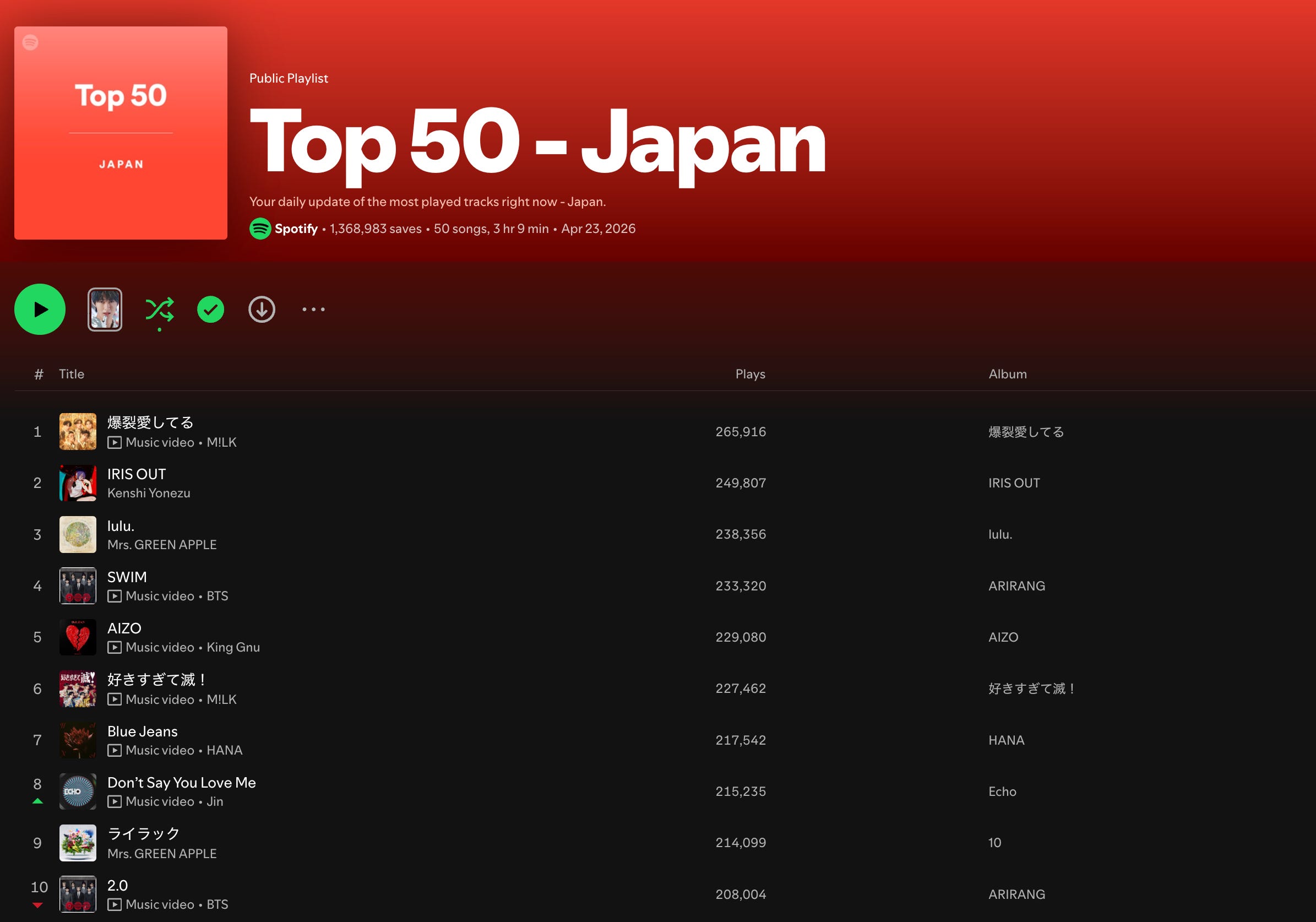
That’s a really crowded set of songs including the biggest hit of last year, new songs from extremely popular bands and a highly anticipated return from the biggest male K-pop group of the last decade1. Yet M!LK have been in the one spot on and off for the better part of “Bakuretsu’s” release. It has been a really wild year for the Japanese charts2 but M!LK have been a consistent topper, and also lay claim to a week on top of the Billboard Japan Hot 100 and even longer stretches dominating YouTube. The members have become regulars on TV and at events.
The only place they didn’t dominate was Oricon, where the physical release of “Bakuretsu” finished second behind STARTO outfit Naniwa Danshi. Oricon, though, isn’t the be-all-end-all chart and by the end of the year, only the fanatics are going to remember the song that sold more physical copies than a number that was always in the air.
It’s a great story, but also one telling a greater story about J-pop in 2026. M!LK connect the dots between a variety of trends that have been bubbling up in recent months, both in relation to a resurgence in rhinestone-dappled idol and in other greater sonic developments.
M!LK synthesize the impact of four artists whose influence is abundantly clear, and shaping how we remember this year. Let’s talk about it.
M!LK Talk #1: ARASHI
Pop staples ARASHI’s final tour looms large over the J-pop calendar. Demand for the quintet’s last jaunt across the archipelago has been huge, with news reports like the above airing in cities before the idols arrive for one last go. It has basically prompted mini economic booms for the areas, with the demand for hotels and transit shooting up. This farewell concludes in Tokyo Dome on May 31, with a monocultural force of the Heisei Period taking one last bow.
I don’t think it’s a coincidence M!LK has skyrocketed into the zeitgeist at roughly the same time ARASHI announced its goodbye shows. M!LK largely lean towards the Showa and Heisei era idea of what male idols are — that’s reflected in the (partial) jaunty pop of its songs and in its dinner-show-ready theatrics, extending to the member’s over-the-top fuzzy duds in the “Bakuretsu” video and general sparkly nature. That image never left J-pop — STARTO routinely dips back into it, while M!LK’s own home Stardust Promotion arguably kept the flame for silly pop alive even as bigger companies started flirting with something more modern — but it sure feels more pronounced in 2026.
One of the few certainties in life is how the proverbial pendulum swings between trends.
The first five years of J-pop in the 2020s was defined by a new era of male group, inspired by or directly shaped by K-pop. You had JO1, BE:FIRST, &TEAM, PSYCHIC FEVER and so many more, most hailing from upstart agencies looking to disrupt the idol landscape. Actual Korean groups, meanwhile, remained massive.
Those neo-idol boys certainly remain popular with devoted fans but…the sizzle is definitely off of them when it comes to the greater cultural landscape. K-pop proper meanwhile seems…kind of in a valley right now? I think the Japanese groups inspired by them got too good, and now a new generation of outfits from South Korea aren’t really dominating the spotlight in the same way they once did, unless you are a real Oricon acolyte. The three groups doing best right now are…BLACKPINK, TWICE and BTS, all of whom have had or will have big shows in Tokyo. They are also all at least a decade old at this point. Even BTS, with a much ballyhooed return, don’t feel quite as attention grabbing as I expected. Yeah, the physical sales are great and Tokyo Dome was as loud as I ever heard it when I saw them last week, but beyond fans and music industry types I don’t think it’s that huge a deal. When one of the members wore a controversial t-shirt during its peak, that was national news and right-wing bait. Today, they get 60,000 plus singing “Arirang” in the capital and nobody cares.
We’ve swung back to old-school idol flair, in part probably due to exhaustion with the K-pop mold and part owing to ARASHI mania3. M!LK deliver that slightly retro feel that many can relate to, and which turns a song like “Bakuretsu” into something familiar to many.
But they didn’t lay the groundwork for a return to idol fundamentals. M!LK really is the first act to benefit from a different kind of powerhouse that showed audiences wanted this dynamic…and, uh, certain readers, turn away now for this harsh truth.
M!LK Talk #2: Mrs. GREEN APPLE
I’ve toyed with it, I’ve really considered it especially after “J-pop Twitter” became insufferable about them…but I just can’t bring myself to becoming a Mrs. GREEN APPLE contrarian. What I have come around to is this trio being the vital bridge between the early 2020s and the new idol dawn of the decade’s second half.
I thought for a long time ARASHI would be the last inescapable entertainment force in Japan when they announced there hiatus in 2020, the final pop project that toddlers and grandmas alike would know due to media saturation. Boy was I wrong, because Mrs. GREEN APPLE remain inescapable. I’ve written enough about that. What wasn’t totally clear until recently, though, was the realization that the group are J-pop tweeners. They are a band at its core, but especially over the last few years as part of its “phase two” operations, they are also idols.
They appear in so many ads. They pop up on TV AND host their own variety show where they goof around with other artists and celebrities. Motoki Ohmori has tried acting out. Hell, it is imprinted in so many of their songs — yeah, you have the rock-oriented stuff, but listen to “breakfast” or “GOOD DAY.” That’s as peppy and positive as any idol offering, complete with choreography and Technicolor videos.
I really think the genius of Mrs. GREEN APPLE was using idol imagery in the context of a non-idol presentation4, thus getting both audiences ready to oshi out and a more general “I just like upbeat music” crowd. They served as a bridge from the glum Vocaloid-indebted rock of the decade’s start — “New My Normal” isn’t about jumping off a building, but it is riffing on the pandemic, which isn’t exactly a bright topic — to the fun sound M!LK typifies.
M!LK strikes me as the first big group to emerge on the other side of the passage Mrs. GREEN APPLE built from bummer times to whatever is happening now. The group’s songs are cheery and upbeat, their visual side is big on bright colors and even the wardrobes are strikingly similar. The idols also pass an important test — do the kids and teachers at my daughter’s kindergarten know their music? The answer has been a resounding “Iijyan!”
Which, by the way…here’s M!LK doing said song at a festival hosted by Mrs. GREEN APPLE, featuring these APPLE Jacks dancing along with it.
M!LK Talk #3: Golden Bomber
When M!LK first started getting attention for the above “Iijyan,” an early talking point centered on it being a ripoff of aespa’s “Whiplash.” Legions of K-pop fans took to social media to express their disdain for this, shocked…shocked!…that another group used vaguely house-music-sounding elements in their song. Didn’t they know Ningning was chopping it up with Frankie Knuckles at The Warehouse???
What those complaining about this missed completely…and, to be fair, not totally their fault as the segment in question was isolated for TikTok, erasing context…was this was a joke, following a much more ARASHI-style bit of gee-golly pop careening into the “cool” part.
M!LK are funny. They get silly, which is central to the history of J-pop idols and such a welcome change from the recent glut of overly serious outfits from the region. Their videos are madcap and feature references to like Ace Attorney. Scroll back up to the “Bakuretsu” clip and take in how ridiculous it is, intentionally so.
I can’t think of the last time a major J-pop group was this goofy on purpose (OK, I can, that’s the next point but stick with me here). I whine about overly serious boy idols but J-pop has been just as stone faced for the most part, with big hits being about the ills of modern society or other downer topics. Mrs. GREEN APPLE certainly helped on the positivity front, but they’ve never been as funny intentionally as M!LK. Which really reminds me of Golden Bomber, a group bordering on the novelty that delivered deliriously wacky comedy songs at a regular clip, albeit often in a more biting tone like one titled “Will you quite the bar hostess.” I think having an act with this edge to them has been lacking for a bit, and M!LK has filled it up well.
M!LK Talk #4: DA PUMP
Everything about what’s happening in 2026 J-pop can be explained by the following video, released nearly eight years ago.
The boring part first — DA PUMP’s “U.S.A.” was one of the first songs to catapult up the mainstream thanks to short-form video (via a then-fledgling TikTok and now forgotten MixChannel) alongside longer offerings on YouTube. It’s a good example of illustrating how Oricon failed as a marker of general tastes and how digital everything in domestic music has become, all applicable to M!LK. It’s also the most Billboard Pro content related to this oddball hit, so let’s not dwell on it.
What the real legacy of “U.S.A.” for contemporary J-pop lays in spirit and sound. Regarding the prior, DA PUMP’s still-baffling super-hit represents the concept of “cool dasai” or “cool lameness,” a kind of irony-gone-beyond-irony appreciation of stupid-looking stuff. Think Don Quijote slippers, leopard print and the entirety of Saitama Prefecture. Watching “U.S.A.” is like witnessing your uncle discovering the Shoot Dance in real time…and eventually being charmed by his attempts at it.
I think that same “cool dasai” energy races through the videos and music M!LK has put out, wrapping up nicely with its idol foundation to create the sort of gaudy-at-first-glance image that proves charming the more time you spend with it. Again, watch the “Bakuretsu” clip — they are flying through space in a convertible! Look how fluffy their clothes are! Across their work, everything M!LK get up to seems a little cheesy5…but I think that’s endearing in 2026.
That extends to the music, and the final key development.
At the end of March, Real Sound ran an article observing how “para para” referring to the hands-centric dancing style seemed to be the trend for Reiwa-era J-pop. What it really means — and is clarified further down — is the sound of Eurobeat. Which made my first thought after reading it…didn’t this already happen? That was “U.S.A.” yeah?
Like literally…DA PUMP appropriated an early ‘90s Italo dance song by Joe Yellow. At that moment it was pure novelty and part of the dasai charm of it all…but in the years since Eurobeat and everything associated with it as actually been embraced by younger folks, probably as part of a larger turn towards the seemingly better past. It became a core influence on Japanese hyperpop, while also being a source of inspiration for highly viral songs made for indie video games6. “Eurobeat intensifies” is a familiar meme.
M!LK’s last two big singles — “Sukisugite Metsu” (above) and “Bakuretsu” (uh further above) — feature what I would call “drops” plunging into Eurobeat, complete with familiar vocal samples, HI-NRG pacing and in the videos para para nods. I think they are among the two most successful versions of idol music embracing this…but aren’t alone. STARTO group Snow Man’s biggest hit in recent times goes even further in this direction…while girl group CUTIE STREET has flirted with the Eurobeat too.
Hell…non-idol outfits like Suiyoubi No Campanella are jumping on it too.
(oh my god, this video is so “cool dasai” that it’s painful, CGI drifting!??!!?! Where’s the Polymarket for J-pop, I kind of want to bet money this gets big)
M!LK have stumbled across…or helped kick off…a bigger shift in what people want from J-pop, and it’s something DA PUMP dabbed across almost a decade ago. It’s silly, it’s a little tacky but in an approachable way, and above all it is fun. It’s a natural shift away from the gloom of the early part of the decade, towards something zanier and also very internet facing. M!LK’s breakthrough isn’t an isolated case…but rather a greater shift, just getting underway in all its silly wonder.
Along with a modern mystery of the Spotify charts…that Jin song that I’ve never heard in the outside world but has been in the top ten for seemingly forever (except a brief plummet when the BTS album came out…but now back).
This could be its own post but to keep it short…the Billboard and streaming charts have basically been a game of hot potato between “IRIS OUT,” “lulu,” “AIZO” and “Bakuretsu,” with a few blips interrupting it (most notably ARASHI’s last single). It’s fascinating because these four songs represent very different sonic paths for J-pop, and it almost feels like…a battle for which way it should go.
There’s also the third and much more tricky reason to unravel…the reckoning with Johnny Kitagawa is well and done, which I do think plays a part in all this, though that’s a minefield for another day.
I stress, this comparison I’m about to make has nothing to do with musical output whatsoever…that said, Mrs. GREEN APPLE is a lot like Perfume in very clearly leaning into idol-dom but never calling themselves idols, which is usually the smartest choice.
Which…includes the “cool” part of the “Iijyan” video, which always struck me as a commentary on how try-hard the sound of, say, a pop group trying to be slick by using club sounds comes off.
I really appreciated this post and agree with everything (I've been telling anyone who'd listen that Mrs. are clearly marketing themselves the same way as idols traditionally have, just with guitars)! I didn't connect the dots to Da Pump, but they certainly did usher in the tonchiki revival.
One more element that I think has really played in favour of M!LK's current success is their positive lyrical content against the current political/social background. Just like, in 1999, people tuned in to Morning Musume telling them "the world is jealous of Japan's future" at a time when the future looked pretty bleak, I think M!LK's messages of affirmation and love resounded with people: "in this narrow world where people easily put a red letter on you for anything, I want us to praise each other" (Ii Jan), "Please just live a healthy life, that's all it takes to make me happy" (Suki-metsu), "The affirmation that comes through a one-tap on a screen doesn't feel enough / Yielding to each other, being kind to each other and love make the world go round" (Bakuretsu). It's a 180° spin on tonchiki songs, where traditionally lyrics sound like coherent sentences but they don't have any meaning. Conversely, beyond their apparent goofiness, these songs give you hope and positively affirm people's differences, and that seems to be just what 2026 Japan needs.
As soon as I thought that wow this WedCamp song would make a great DDR track, non-copyright infringing arrows were speeding across the screen.
I hope M!LK’s success with silliness brings fellow Stardust group Bullet Train back to the silly station too. They’ve had too many earnest music videos lately and not enough training sequences in dojos and clutching random baguettes.